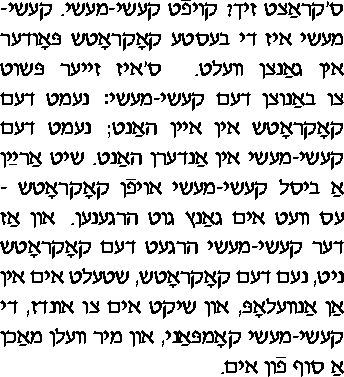
| With
all the attention being given to the current war problems, interest is
growing on the origin of the "Stan" in many of
the nations involved, including the formerly named nations of Afgan, Paki,
Turkmen, Uzbek, Kazak, and Kyrgyz.
You may recall the late Stanley W. Zublinsky
of Port Royale, OK, who--in 1935--invented the first stainless steel,
multi-purpose waffle iron. Stanley's creation took off like hot cakes.
He made millions and went public, Zublinsky Enterprises. The company
was sold to a large conglomerate, leaving Stan with large amounts of cash
and time. He ran for office numerous times, all unsuccessful--even
his candidacy for Oklahoma Superintendent of Documents. Still, Stanley
Zublinsky wanted a legacy that went beyond the waffle iron, which no longer
was associated with his name or defunct company. He approached some
of the world leaders in a financially strapped area of the world regarding
his desire to be remembered, and their need for hard cash.
Would the Republic of Afgan,
for example, be willing to adopt Stanley Zublinsky's name in exchange
for American dollars?
Afgan would become Afganizublinsky. That was too much even for the
poorest of nations. But a compromise was struck, based on his first
name. The rest, of course, is history. Also geography.
|
| Recently,
there was "Jewish Night" at Shea stadium
(NY Mets). My friend and I went, and we decided to send out two trusty
virtual reporters, Ella Rina (E.R.) and Ella Tfila (E.T.) down to the field
with hidden nanophones (that's 1/1000th of a microphone) to determine the
answer to that age old question:
"What
are they discussing on that Pitcher's mound?"
Ella Rina has explained to us that there are,
basically three types of conversations:
- The chevruta - This is when the Catcher alone
goes to the mound to talk to the Pitcher.
- The
shiur - This is when the manager goes to the mound the first time in
an inning.
- The
mussar - This is when the manager goes a second time to the mound. Inevitably,
this must be some severe punishment, as this is immediately followed
by the Pitcher leaving the game. Typically, Pitchers try to avoid the
mussar.
Ella
Tfila reported on some of the conversations that occurred during the August
4, 1998 Mets Game vs. The San Francisco Giants. To avoid "lotion horror" and
possibly being ejected from future baseball games because of slander and playing
with the rosin bag, Ella does not mention any of the players' real names. Of
course, Ella doesn't KNOW any of the players' real names, anyway, but that's
beside the point.
In the top of the third, the Mets Catcher went
to the mound for a chevruta:Pitcher:
So, nu? Vat's de matter now? Catcher: Listen, I just want to tell you that
you should Pitch no higher than 1 amah out of the strike zone, because even
bedi'eved (by leniency), the umpire won't call it a strike. And try to speed
up your Pitchers so we can all get out of here before sof z'man kriyat shema
(end of time for reciting Shema), OK?Ella Rina explained what goes through
a Pitcher's head between Pitchers. Have you noticed he walks around the mound
too much, picks up the rozin bag, drops it, rubs his hands, chews tobacco,
spits, scratches himself, all before he finally throws a ball to home plate?
What is going on all this time?
E.R.
explains that the Pitcher is contemplating a tough sugya (section) of the
Talmud. The walking around the mound is to fulfill the precept, "vehalachta
bidrachav."
"Thou shalt walk in his path." The Pitcher would rather himself
walk in His path than walk the batter to first base! The use of the rosin bag
is an allusion to the children of Israel all united in one place. The baseball
field is partially made of sand thus resembling Israel as the "sands of the
Earth",
thus scattered about. The rosin bag represents the collection of these scattered
grains in one place forming unity and thus, controlling the destiny of the
game. After all, the game cannot continue until the Pitcher Pitches the ball!
The tobacco chewing and spitting is simply because the Pitcher gets hungry
on the mound. Since the mound may be considered a makom (place of) tum'ah (unclean),
the Pitcher cannot make a bracha (blessing) prior to eating. Hence, by chewing
tobacco and spitting it out, he is not really eating, thus he need not make
a bracha.The scratching minhag (custom) originated from a mistranslation of
a Yiddish word.
Many
years ago, when Sandy Kofax was losing a game, and things looked bleak,
he went off the mound and began to krechtz (sigh), "Oy vey! Vat
a day! How do I make this batter strike away?" From there came the expression,
and rule, "A Pitcher who is in trouble should krechtz to relieve his frustrations." However,
as Kofax passed on, and got into The Hall of Fame, people started to say, "A
Pitcher who is in trouble should kratz (scratch) to relieve his frustrations." Thus,
came about the custom to scratch rather than to sigh. E.T. explains that
the reason the Pitcher keeps nodding his head "yes" and "no" is
that he is contemplating the result of a makhloket (dispute) and it takes him
some time to decide which Rabbi might be right. Occasionally, the Pitcher really
cannot decide, as E.T. discovered the other night when there was an "expanded" chevruta.
The first baseman joined in together with the Catcher on the mound. 1st base: "Hey
guys? What's the problem.
Catcher:
Now, I thought I told you what the signals mean. Index finger means Bet
Shamai, Pinkie means Bet Hillel."
Pitcher:
Oh, was that it? I thought the index finger meant Hashem is watching and
the pinkie meant "let's have fleishigs (meat) after the game!"
1st
base: "No, you shmendrik and a half! The index means throw a
fastball and the pinkie means that the Catcher has an itch on his index but
can't get his finger out of the glove. Got that? Meanwhile, the yoompar (umpire)
has joined in on the chevruta also.
Yoomp: "Hey!
You guys are taking too long! My wife said not to come home so late because
I'll miss tikun chatzot (midnight prayer). Let's get on with the game,
OK?"
Sometimes,
E.T. says, it's hard to tell the difference between the expanded chevruta
and a shiur. The difference, of course, is that a shiur always involves
the manager, where the chevruta never does. Problem is, sometimes the manager
TELLS the players to make an expanded chevruta, in which case, technically,
this is a shiur, but not really. E.T. refers to this as a "syag leshiur" (building
a "fence" around the shiur). I just prefer to call it an excuse! In the 8th
inning, it seems that the Giants Pitcher got into some trouble. They were one
run up, but had the Mets fastest runner in scoring position. A shiur occurred
on the mound.
Manager to Pitcher: Now, we're taking dinner orders. We decided
we're going for Chinese food tonight.
Pitcher: But I prefer chulent!
Mgr:
I'm sorry, but we've had enough chulent the last few nights! Now, you better
tell me now, you want Moo Goo Gribenes (chicken fat, with the hardened
skins) or Sweet and Sour Egg Kichel? (The only "mop" and "shovel" good
enough for pickled herring onions. A necessity when you run out of toothpicks!)
Pitcher:
I don't know. Let me get this last guy out, and I'll let you know in the dugout
between innings, OK?
Mgr:
OK, but you better finish it soon, 'cause the boychiks ("dem bums!")
here are getting mighty hungry. Well, it seems that the thought of food made
the Pitcher lose concentration. He not only walked the next batter to load
the bases, but he had a wild Pitcher, and walked the next two after that. This
was far more than the manager and the dug-out-chiks could tolerate.Mgr: OK,
what's the problem. Why did you allow three men to score?
Pitcher: I'm sorry, I was hungry. You know, I was thinking about getting
Liver Lomein with an Egg Keichel Roll.
Mgr:
Are you meshugah? You were hungry? That's what cost us three runs??? You
were hungry? Get outta here and get the whole team some food! The whole
dugout is hungry! Come on! Give me the ball! (Oy! He was hungry! Ah nechtigeh
tog! ("Why didn't I trade him yesterday?"))
Well, now that you have some idea of why baseball games take so long, I would
suggest that next time you go to the park or stadium you might want to take
a Ramba"m
(Maimonedes explanation). I have a feeling he might explain what the BATTERS
do when they step out of the batter's box between Pitchers.
Until then, this is Ella Rina and Ella Tfillah saying if you understood this,
then you're a Maven. |
| by
Joe Hample (sung to the tune of "As
Time Goes By" from "Casablanca")
You must remember this,
A bris is still a bris,
A chai is just a chai.
Pastrami still belongs on rye,
As time goes by. With holidays in view,
A Jew is still a Jew,
On that you can rely.
No matter if we eat tofu
As time goes by. Old shtetl customs, never out of date.
All those potatoes someone has to grate.
One flame in the window,
keep counting till there's eight
To light the winter sky. In the Bronx or in the Mission,
It's still the same tradition,
That no one can deny.
We roam, but we recall our birthright,
As time goes by. Dreidels and chocolate, never out of date.
Ancient Semitic glories to relate.
Blue-and-white giftwrap, ain't this country great,
And festive chazerai!
It's still the same old Torah,
It's still the same menorah,
We've latkes still to fry.
December's when I feel most Jewish,
As time goes by.
|